What it is
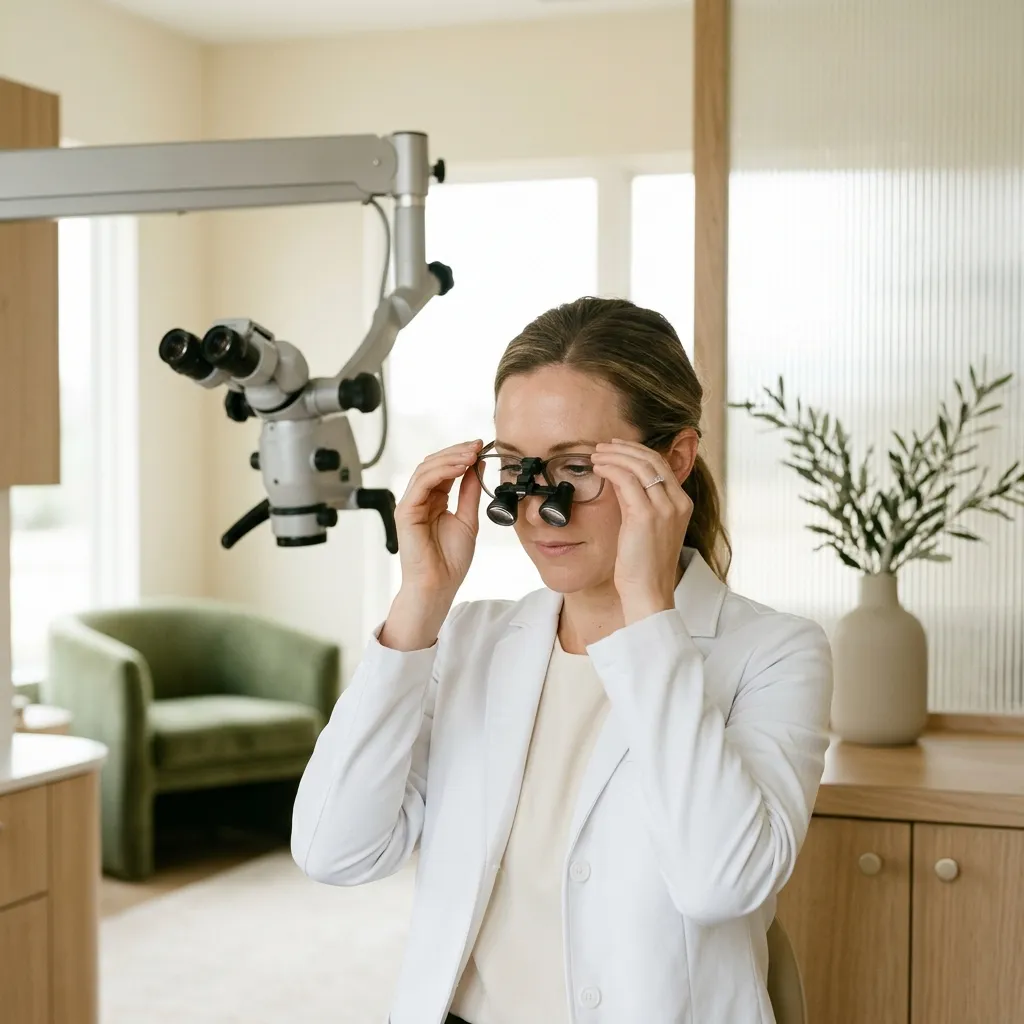
Loupes are magnifying lenses fitted to glasses, with a bright light. Our dentists and hygienists wear them for every treatment, usually at 2.5 to 4 times magnification. They make it possible to remove only the damaged part of a tooth, see where a filling or crown meets the tooth, and find tartar that would otherwise be missed.
A dental operating microscope goes further, with up to around 20 times magnification and light that shines straight down into the tooth. It is used for root canal treatment, where canals can be thinner than a hair — including the extra canal often found in upper molars.
A canal left untreated is one of the main reasons a root canal fails.
What you notice
- Not much — that’s the point. Loupes look like glasses with small lenses. The microscope sits above the chair on an arm and never touches you.
- A comfortable position. Magnification lets us work with good posture, so you can rest with your head back.
- Pictures if you like. The microscope can record images, and we can show you what we found.
What it changes — and what it doesn’t
What you gain
- Smaller fillings: only damaged tooth is removed
- Better-sealed crowns and fillings
- Root canals that find and treat every canal
- Cracks spotted early
Its limits
- Magnification helps a skilled hand; it isn’t a treatment by itself
- Very complex root canals may still be referred to an endodontist
Why it matters for a root canal
A canal left untreated is one of the main reasons a root canal fails. Studies consistently find that clinicians locate more canals with a microscope than without one — especially the second canal in the front root of upper molars.